


This is post #8 in the WPC blog. Click here to visit the blog homepage.
Guì Zhī Fú Líng Wán is a well-known herbal formula from the Jīn Guì Yào Lüè chapter 20, Claus 2, on treating pregnant women. The original line states:
1. Among women with a history of concretions, if there is no menstruation for three months, when dripping of blood begins without stopping, and there are fetal movements above the umbilicus, this is damage from intractable concretions.
2. When there is movement in the 6th month and no bleeding for the previous three months, this indicates pregnancy.
3. If there is bleeding followed by three months of no bleeding, this is coagulated blood. This causes bleeding that does not stop and results from concretion that has not receded. One should purge the concretion. Guì Zhī Fú Líng Wán governs.
This line is interpreted in different ways. Because this line is in the pregnancy chapter of the text, it is generally assumed that Zhāng Zhòng-Jǐng is recommending using Guì Zhī Fú Líng Wán for women with concretions during pregnancy. However, many lines in Zhāng Zhòng-Jǐng's texts are written to help the practitioner rule out pathologies that may otherwise be easily misdiagnosed. I believe that this line is one of these.
Before the time of pregnancy tests, because the presence of a uterine concretion can look like pregnancy and can be accompanied by amenorrhea, it may have been easy to be confused about whether a woman was pregnant or had a concretion. I will explain below:
In #1 above, Zhāng Zhòng-Jǐng discusses a situation in which a woman is pregnant and begins to bleed because of the presence of a lump. We know there is because of a lump because the fetal movements are above the navel, where they shouldn't be, at only three months.
In #2, he discusses a healthy pregnancy with no bleeding and expansive fetal movements that are normal.
In #3, he is discussing a situation that may look like pregnancy because of abdominal expansion and lack of bleeding, but it isn't. Instead, it is a concretion that has stopped the blood. It is only in this case that Guì Zhī Fú Líng Wán should be used.
I have read and translated many cases in which Guì Zhī Fú Líng Wán is used, and almost none of them are pregnant women with lumps. I have only read two instances in which Guì Zhī Fú Líng Wán was used during pregnancy outside of its use for labor induction. In both of these cases, the lump was threatening the life of the fetus, so heavy measures were called for. Without the herbs, the baby's life would end, so how could it hurt to try?
My main point is that I do not use this formula during pregnancy. I read this to say that Zhāng Zhòng-Jǐng was warning us to differentiate pregnancy from lumps so we avoid purging a pregnant woman. Though coagulated blood is a pathological substance that interferes with and threatens many pregnancies, we rarely have situations that call for purging in pregnancy. The purgative aspects of this formula contraindicate it for most pregnant women. At the same time, Zhāng Zhòng-Jǐng tells us that this formula is excellent for coagulated blood in the lower body.
Guì Zhī Fú Líng Wán is a small formula of five herbs. This makes it very modifiable.
Below is a wonderful discussion from Dr. Chen Chuang-Tao's Xiao Lang's Chinese Medicine Diary: My Chinese Medicine Internship Story. He is telling us that his teacher had great skill in modifying Guì Zhī Fú Líng Wán, which was the secret to making it work!
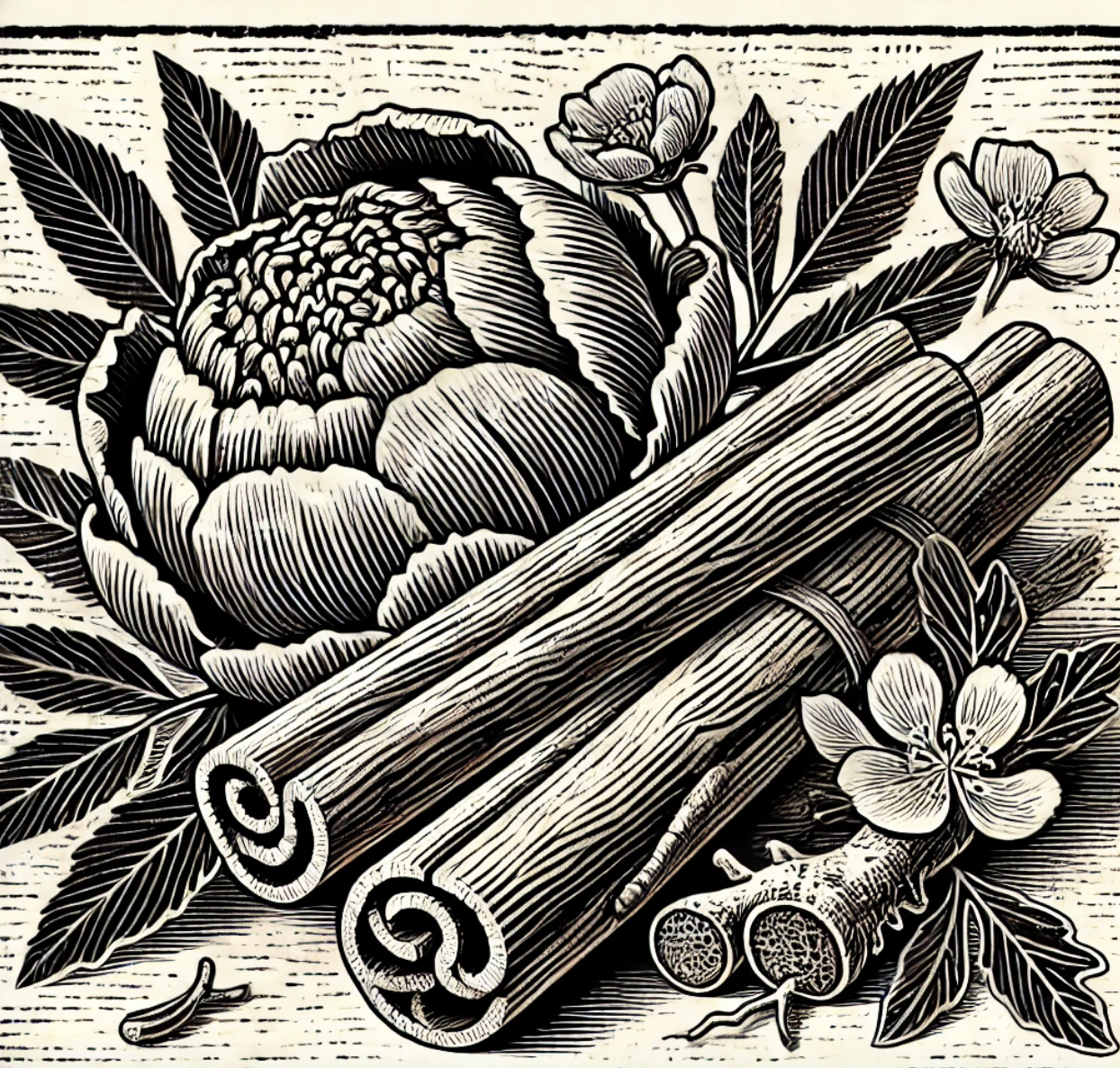
Guì Zhī Fú Líng Wán for Treating Uterine Fibroids
A gynecologist in the county hospital was very good at treating gynecological diseases. He used Guì Zhī Fú Líng Wán to treat uterine fibroids, and he used it to perfection. When others used it, the effect was not very good, but the results were excellent in his hands. One can't help but consider whether these results were because of the herbal formula or the doctor.
The gynecology expert said that knives are all sharp; accurate slicing depends on whose hand they are in. If it is in the hands of ordinary people, it will be blunted quickly. If it is in the hands of a cook equal to the task, it remains extremely sharp.
Ultimately, learning traditional Chinese medicine and ancient prescriptions is not about using classic prescriptions to cure diseases. It is about the flexible use of prescriptions. It is the people who treat diseases and not prescriptions.
A patient with uterine fibroids took a lot of Guì Zhī Fú Líng Wán , but the fibroids did not disappear. Later, the patient found the gynecological expert of whom I speak, and he still gave the patient Guì Zhī Fú Líng Wán , but with the addition of Xiao Jin Dan. As a result, the fibroids disappeared quickly.
Why was this so effective?
It turns out that this woman with uterine fibroids had a deep, rough, hardened pulse, indicating that the blood stasis was deep and hardened, so it was necessary to more strongly vitalize and dispel blood stasis. Taking medicine during menstruation drives the blood stasis out of the body along with menstruation. As in the Art of Warmth, which suggests "guiding one's action according to the circumstances," the timing of taking medicine is critical.
When Master Jiāng talked to him about the Guì Zhī Fú Líng Wán, the gynecologist explained the truth behind it in just one or two sentences. He said the Huáng Dì Nèi Jīng states that when the uterus receives cold, the cold Qi binds with the liquid, foam, and blood to form a clot. This changes into congealed blood and phlegm fluids. Therefore, this specifies the prerequisites for the accumulation. There is cold binding, phlegm fluids, and congealed blood. All of these conditions must be there. They are the constituents of many of the body's lumps. If the cold Qi is predominant, there should be warming and the scattering of cold. If the phlegm fluids predominate, there should be more seeping of dampness and transformation of fluids. If congealed blood is predominant, there should be more vitalizing of blood and transformation of the congealed blood.
The process that creates uterine fibroids is the same as for all lumps. The medication dosage will also vary because the balance of the pathology of cold Qi, phlegm fluids, and blood stasis differs in each case.
Master Jiáng asked him for advice on using Guì Zhī Fú Líng Wán when treating uterine fibroids and the accumulations of various other gynecological diseases. The gynecology expert said that although Guì Zhī Fú Líng Wán has only five herbs, they are all aimed at the major pathogenesis described above.
Gui Zhi resolves the exterior, grasping and tearing away the exterior layer of cold Qi. What is the function of Fu Ling? It enters the San Jiao, transforming fluids. It can also grasp phlegm fluid and water damp to seep and open up. The three herb flavors Tao Ren, Chi Shao, and Mu Dan Pi are especially suited to treat blood stasis. They can break up the blood, discharge blood stasis, and promote the smooth flow of qi and blood. Therefore, the five medicinal herbs have three functions: warming Yang and dispersing cold, transforming and removing water fluids, and expelling blood stasis. This way, local accumulations, such as uterine fibroids, can slowly dissipate.
When I heard this, it suddenly dawned on me that Chinese medical treatments turned out to be so scientific. The formation of the disease is like a chemical reaction. Cold Qi, phlegm, and blood stasis are wrapped together and combined into lumps to form uterine fibroids.
Guì Zhī Fú Líng Wán causes Yang to govern Qi transformation, allows water to circulate, and congealed blood to transform and disperse. These accumulations will be decomposed into turbid yin and expelled from the body, so the masses blocking the uterus will disappear.
Master Jiáng nodded and told me that my analysis was excellent. Traditional Chinese medicine requires scientific thinking to be carried forward, pattern differentiation must be done with a meticulous spirit, and the application of herbs must be done with a precise attitude. The reason why this expert in gynecology has treated countless uterine fibroids with excellent results is that he is good at applying the "Shāng Hán Lún," flexibly using the ancient prescriptions, pouring over the "Huáng Dì Néi Jīng," and diligently studying ancient precepts.
1 小郎中学医记:我的中医实习故事 ("Xiao Lang's Chinese Medicine Diary: My Chinese Medicine Internship Story") by Chen Chuang-Tao, People’s Military Medical Publishing Co. June 1, 2015
2 Zhi Cao Wu, Wu Ling Zhi, Ru Xian, Mo Yao, Chao Dang Gui Shen, Di Long, She Xiang, Bai Jiao Xiang, Mu Bei Zi, Mo Tan.
Please log in or sign up to comment.