
In Classical Chinese Medicine, Elation (xi 喜) and Joy (le 樂) are both related to the Heart-mind and to the Fire Qi. However there are significant differences between the two. Regardless of which English word is chosen to translate each Chinese character, unhealthy xi (喜) is an excess of the Fire Qi, while in contrast, le (樂) cannot usually be in excess, only in deficiency. Elisabeth will take you on an exploration of meaning of each character and their clinical differences. She will examine how Elation (xi 喜) and Joy (le 樂) correspond to the double aspect of the Fire, sovereign and minister.
| White Pine Circle Members | Inner Circle Members |
| $40 ENROLL NOW | FREE ENROLL NOW |
*Upgrade now to save, cancel at any time.
1.5 credits NCCAOM (Pending for Course, Provider #287)
This course has been approved by the California Acupuncture Board, Provider Number 679, for 1.5 hours of continuing education
Learning Objectives
1) Upon completion, participants will understand the translation of the characters for Elation (xi 喜) and Joy (le 樂).
2) Participants will be able to determine the different clinical manifestations of both elation and ajoy.
3) Participants will be able to crestre treatment plans based on the classical literature.
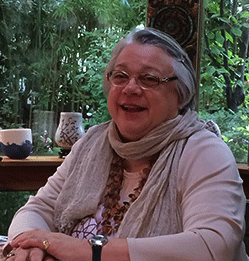
Born in Paris in 1949, I studied philosophy, literature and classics at the Paris University where I completed my Masters degree in Classics and in Philosophy then in Chinese.
When I was 20, I met Claude Larre s.j. while he was working on his PhD thesis on the Huainanzi and translating the Laozi. As a result of his influence, I began to study Chinese, working with him on Chinese classical texts. I also studied modern Chinese with a native speaker and spent a year in Taiwan (1974) to further my studies.
In the early 1970's, Father Larre met Dr. Jean Schatz, a western physician with an interest in oriental medicine He was an acupuncturist with a special interest for the classical medical texts. At this time I embarked on a study of Chinese medicine, and together with Dr. Schatz and Father Larre, began the first study group of the classical medical texts in Paris. This lead to the founding of the European School of Acupuncture in Paris in 1976.
(See the E.E.A. site and the presentation page in this site for more details.)
From this common work, Father Larre, Dr. Schatz and myself co-authored A Survey of Chinese Medicine, published in 1979 (English translation published in 1986).
Under the auspices of the Ricci Institute in Paris, Father Larre and I offered lectures, seminars and conferences on Chinese classical thought; this teaching was given not only in Paris and other French cities, but also in several European countries and shortly in America. We also published numerous booklets on the seminal texts of Chinese medicine and philosophy.
In the mid 1980's, I began to accompany Father Larre on his teaching engagements in both the UK and the US. Father Larre’s subtle understanding of the background culture and philosophy and my knowledge of the medical texts combined to produce a unique teaching team.
I also worked closely with Father Larre on the Grand Ricci dictionary, completing the first publication – two volumes of single characters – in 1999. The complete work of seven volumes was finally published, under my direction, just before Father Larre’s death in December 2001. This awesome achievement is a testament to an inspiring collaboration which lasted over 30 years.
I continue to teach worldwide, working with both medical and philosophical Classics. I was lucky enough to find good friends and partners to work with, such as Sandra Hill for the editing and publication of books in English through Monkey Press, Peter Firebrace for teaching in London with Orientation; Ken and Jessica Rose in the US with whom I co-founded the Three Spring Institute, and many others in different countries and languages.
I do think that a real knowledge of the Chinese vision of life is useful not only to understand Chinese medicine from a scholarly point of view, but also to deepen one’s practical approach and clinical skill. It is the reason why I always read, translate and explain texts which present a precise pathology and its diagnosis treatment or a reflexion on the nature and meaning of human life or anything in the between.
I love what I do and wish to continue as long as I can. I like and value the Daoist approach of life, especially Zhuangzi and Laozi, while remaining a Christian. I am sensitive to Chinese calligraphy, poetry and painting. Some of the artworks of my favorite painter, Zhu Da (Bada Shanren) are used on this site.